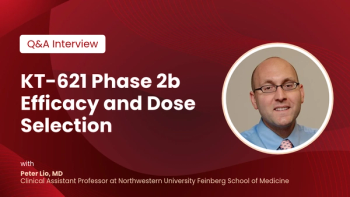
Peter Lio, MD, discusses phase 2b KT-621 data and how an oral STAT6 degrader may fit alongside biologics for moderate to severe atopic dermatitis.
Peter Lio, MD, discusses conjunctivitis counseling, phase 3 expectations, and access hurdles for KT-621, an oral STAT6 degrader for atopic dermatitis.
In the phase 2b BROADEN2 trial assessing
Efficacy in the 244-patient, 16-week study supported further development, with the mid-dose cutting mean Eczema Area and Severity Index (EASI) scores by 72% vs 27% with placebo (P < .0001).¹ Pruritus improved in parallel, as 52% of mid-dose patients achieved a reduction of 4 or more points on the peak pruritus numeric rating scale vs 13% with placebo (P < .0001).¹ The phase 1b BroADen study previously showed a 62.6% mean EASI reduction after 4 weeks of treatment in 22 adults.²
Kymera plans to start its first phase 3 atopic dermatitis trial by mid-2027, pending regulatory alignment, and 230 BROADEN2 participants have entered a 52-week open-label extension.¹ No head-to-head trials against injectable biologics have been conducted.¹ Peter Lio, MD, clinical assistant professor of dermatology and pediatrics at Northwestern University Feinberg School of Medicine and founding director of the Chicago Integrative Eczema Center, brings a clinician's view to these questions.
Lio discusses how he would counsel patients on conjunctivitis risk, the evidence he wants from phase 3, and the coverage hurdles likely to shape uptake of an oral STAT6 degrader:
Peter Lio, MD: In a way, I was kind of happy to see that. Part of me was hoping conjunctivitis wouldn't be seen with this drug because, in theory, even though it's the same pathway, it's one step beyond. There was a hypothesis out there that blocking IL-13, or affecting that pathway, might be what caused conjunctivitis. Cells in the cornea actually require IL-13 signaling, so there was this idea that maybe if you skip that step, you could avoid this. But apparently, that is not the case.
The other part of me feels pretty relieved. This really does make it feel just like the other drugs in that pathway. It almost seems like it could be practically indistinguishable, which in a way is great, because that's what patients have been asking for: "Can you give me a pill version of dupilumab?" In a way, it really does deliver.
So what would I do? Nothing differently. I would still do good anticipatory guidance around it and explain the potential risks. We do need to make sure we are keeping a close eye on it, because we know that left unchecked and untreated, it can actually damage the eye. There are reports of visual loss from untreated severe conjunctivitis and keratitis, so we want to be very careful. That being said, I still overwhelmingly classify these as more of a tolerability issue rather than a safety issue, because if we intervene, generally speaking, there's no permanent damage.
Peter Lio, MD: I will be very excited to see how the phase 3 trial comes out. We have had our hearts broken in the past by amazing phase 2 data that didn't pan out. But I feel pretty excited, because I think everything points to the phase 3 data, with larger numbers and a more longitudinal phase where we can learn a little more about what happens next, really slotting this medication in alongside our biologics. For me, that's going to shape the patient discussion: "Look, here's an option that's very similar to the other medicines we've had in this category, but now, for the first time, we can give you this as a pill." That's going to change everything.
Of course, it's not approved, and we haven't had all the data yet. But I expect it not to have any lab monitoring requirement. I expect it to be classified as truly not an immunosuppressive, which is really important. I don't expect any drug-drug interactions, as with the other members of this class. So I really think this could be exciting.
When we think about analogies, for example, in psoriasis, we have oral apremilast, which arguably was lower in efficacy compared with the biologics at the time it was released, but it was still really important. I remember being, honestly, kind of flummoxed. I thought, "Here we have this milder drug. It's not very effective, but it's pretty safe." A lot of patients said, "Let's start with that one, because if it works, I'll be happy." And I thought, "That's a good point. It's reasonable to try it, even though the efficacy is not the same." So even when the efficacy was lower, people were excited to try an oral. Now, if we can say the efficacy is comparable, roughly similar, or potentially similar, I think many patients are going to say, "Why don't we start with that?"
Peter Lio, MD: That's always a good question. Increasingly, that is the nature of clinical work: dealing with the accessibility part. When I started practice, that was not a thing, and now it is a major industry and a huge middle layer of work and responsibility we all have to deal with. So yes, it's always important. What makes me nervous, especially when a smaller company has a drug, is whether they will have the resources to support patients and clinicians. For better or for worse, and I would argue the whole thing stinks, I wish we didn't have to deal with this at all and could just get the best medicine for the patient. But that's not the reality. The reality is we have to get things that are truly accessible to patients, and many times it depends on good rebates and good insurance contracts. If the insurance company says, "This is going to be third line," we're in trouble.
But if the insurance companies can say yes, it's priced comparably or, hopefully, lower, and we think about the cost to the system, there's an enormous cost when we use our biologics. You need a cold chain transport system. It has to stay cool. There's all this packaging, needles and disposal of needles, and all the sterility involved. There's a lot of hidden expense. So my hope is that we can pass some, or hopefully most, of those savings on to our patients and the payers and say, "Look, these pills are easy. They can be stored at room temperature. We can put them in the regular US mail." That's going to cut a lot of baloney out. For patients who are limited by that in certain parts of the world, people who travel a lot, or people who are needle phobic, this suddenly becomes a potential option that never existed before, and that's a big deal by itself.
Editor's Note: This Q&A transcript has been edited for grammar and clarity using artificial intelligence tools.
References